Stop Being Generic: How to Write a CAAPID Statement of Purpose That Actually Gets You Interviewed
Written By:
Dr. Samantha Lynch
DDS
Delete it.
Right now, before you read another word of this article — if your CAAPID Statement of Purpose opens with any version of the following sentences, highlight them and press backspace:
“Ever since I attended a dental camp as a child, I knew dentistry was my calling.”
“Dentistry is the perfect blend of art and science.”
“I have always had a deep passion for helping people smile.”
We are not being harsh, Doctor. We are being honest with you in the way a senior colleague would be — the way someone who has actually sat on an admissions committee, or mentored dozens of international dentists through this process, would tell you the truth before it costs you an interview.
Those lines are not just weak. They are invisible. Admissions readers have processed thousands of statements. Their pattern recognition for generic writing is instantaneous, and the moment they see one of those phrases, your narrative — your story, your sacrifice, your entire journey to this country — gets filed in the wrong mental folder.
You did not move continents, work survival jobs, and rebuild your professional identity from scratch to get filed in the wrong folder.
This guide is about making sure that does not happen. We are going to show you exactly what separates a forgettable CAAPID Statement of Purpose from one that makes a program director pause, lean forward, and reach for the interview shortlist.
This is not a grammar lesson. This is a smart strategy for the most important document in your CAAPID application.
Table of Content:
- Why the CAAPID Personal Statement Is a Filter, Not a Formality
- The Golden Rule: Show, Don't Tell — With Real Before & After Examples
- Stop Writing a Second CV: The Value-Add Framework
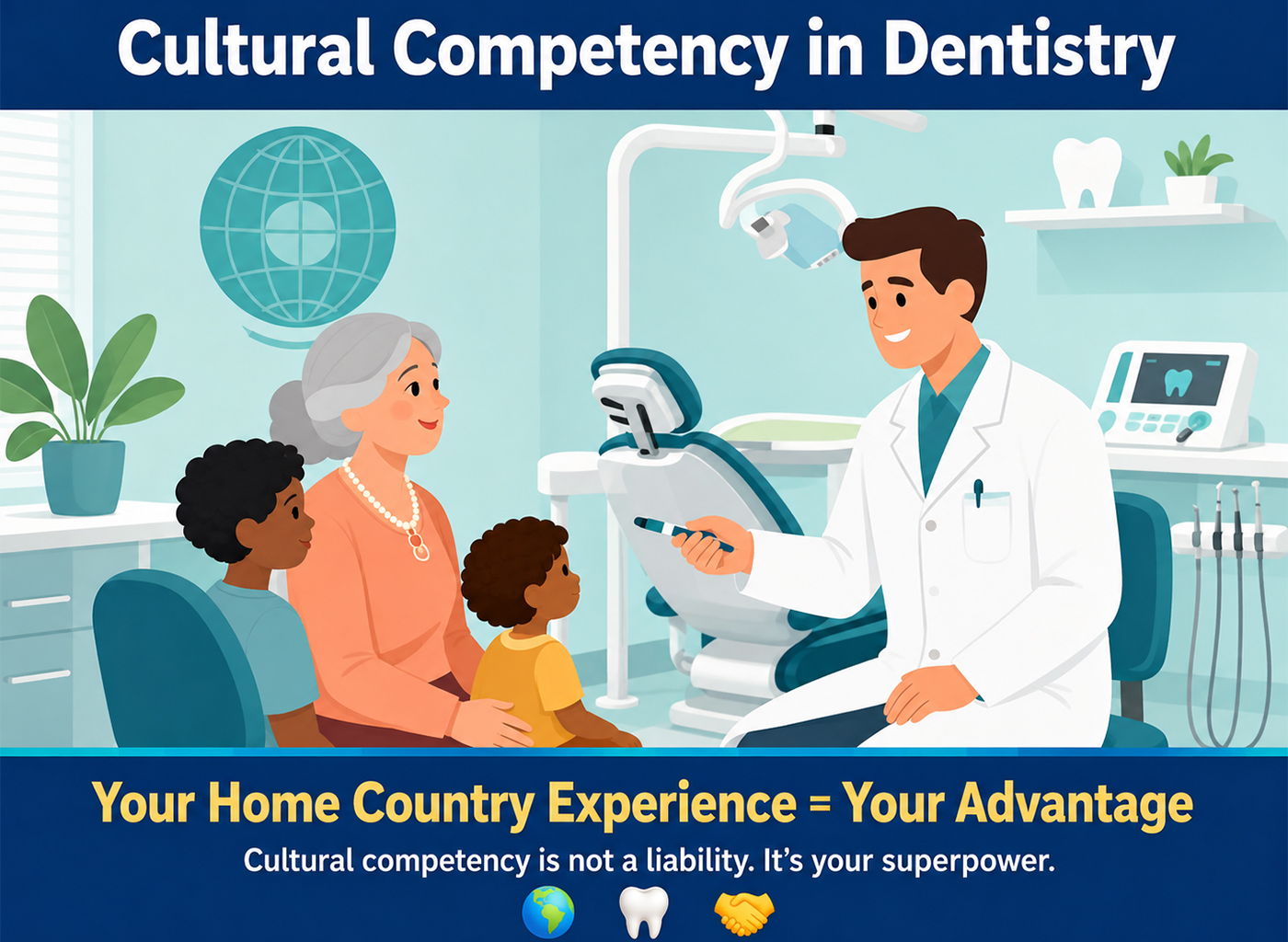
- How to Turn Your Home Country Experience Into Your Competitive Advantage
- The Architecture of an Unforgettable Statement: A Structure Guide
- Common Mistakes That Are Silently Killing Strong Applications
- Frequently Asked Questions About the CAAPID Personal Statement
- Your Next Step: Your Story Deserves to Be Told Right
Why the CAAPID Personal Statement Is a Filter, Not a Formality
Let’s establish something important before we get into the craft of writing.
The CAAPID Statement of Purpose is not a box-ticking exercise. It is not a thank-you note to the admissions committee. And it is absolutely not a place to summarize information that already appears in your transcript or CV.
It is a filter.
Advanced Standing Programs receive hundreds — in many cases over a thousand — applications from internationally trained dentists every single cycle. The applicant pool is, by definition, composed of accomplished clinicians. Every person in that pool has a dental degree. Most have years of clinical experience. A significant number have strong INBDE scores and competitive GPAs.
So how does a program director distinguish between candidates who look nearly identical on paper?
They read the statement.
More specifically, they look for a candidate who demonstrates self-awareness, clinical maturity, and genuine readiness for a U.S. or Canadian training environment — not just someone who can recite their accomplishments in paragraph form.
A generic statement is not just a missed opportunity. It is an active signal that the applicant has not thought deeply about who they are, what they bring, and why this program, specifically, is the next right step in their clinical journey.
The programs you are applying to are not looking for the most accomplished dentist. They are looking for the most ready colleague.
Your statement is your one chance to answer the question they are actually asking: “Is this doctor going to thrive in our program — and make our program better for having been here?”
At Simpli Boards, our application mentors work with international dentists at exactly this stage — when the scores are strong but the narrative is not yet translating on paper. The gap between a good application and an interview invitation is almost always in the statement.
The Golden Rule — Show, Don't Tell (With Real Before & After Examples)
This is the single most important concept in personal statement writing, and it is the one that international dentists most consistently struggle with.
It is not a language barrier issue. It is a training issue.
In scientific and academic writing — the kind most dental graduates did in school — you state facts, cite evidence, and reach conclusions. You write: “The patient presented with…” and then you describe. That style is precise, professional, and completely wrong for a personal statement.
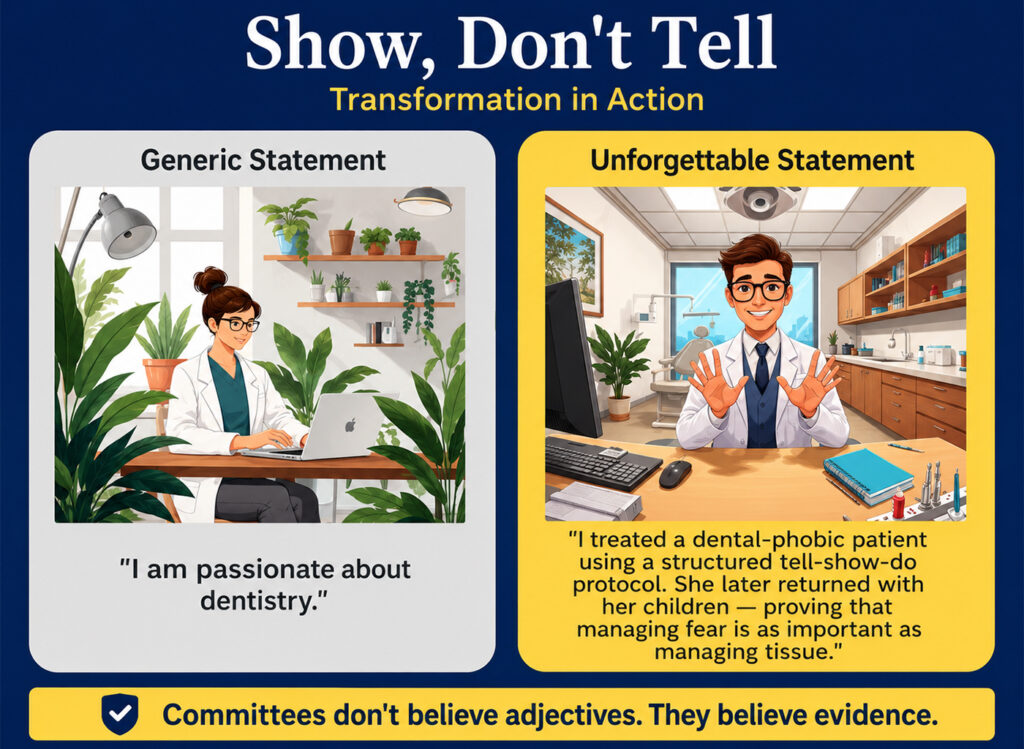
A personal statement requires narrative writing. And narrative writing operates on one foundational rule: committees do not believe adjectives. They believe evidence.
What “Telling” Looks Like
Telling is when you describe yourself using heavy adjectives and expect the reader to accept them at face value.
“I am highly resilient, compassionate, and possess excellent clinical skills. I adapt easily to new
environments and have a deep commitment to patient-centered care.”
Read that sentence again. Every single word in it is a claim without a shred of support. Any applicant on Earth could write that sentence. It says nothing that distinguishes you.
What “Showing” Looks Like
Showing is when you replace the adjective with a story that makes the reader feel the quality you are trying to demonstrate — without you ever naming it.
If you want to show resilience, you do not write the word “resilient.” You write the moment that proved it.
If you want to show clinical skill, you do not write “excellent clinical skills.” You write the patient case that tested you and what you did.
Here are two concrete transformations to make this tangible.
Before & After Example 1: Demonstrating Motivation and Public Health Commitment
❌ Before (Generic): “I have a deep passion for treating underserved communities, which is why I want to study in your esteemed program.”
This tells us nothing. It is a stated intention attached to a flattering adjective. Every applicant claims passion. None of them prove it in this sentence.
✅ After (Unforgettable): “When our clinic in [Home Country] ran out of composite materials during a monsoon supply shortage, I spent three days coordinate-mapping local triage clinics to share resources so forty pediatric patients would not lose their appointments. That chaotic week taught me that public health is not about perfect conditions — it is about resourceful leadership. It is the standard I am bringing to an Advanced Standing Program.”
Notice what happened. The word “passion” never appears. The word “underserved” never appears. But you felt both of them. You saw a doctor who, when the system failed, did not accept the failure. That is what the committee needs to see.
Before & After Example 2: Demonstrating Clinical Skill and Patient-Centered Philosophy
❌ Before (Generic): “I am an expert at extractions and crown preparations, and I always make sure my patients are comfortable in the chair.”
This is a CV bullet point with softened edges. “Always make sure patients are comfortable” is a baseline expectation, not a differentiator.
✅ After (Unforgettable): “In my home practice, I treated a highly dental-phobic patient who required a complex molar extraction. Rather than defaulting immediately to sedation, I implemented a structured tell-show-do protocol across two preparatory appointments. By the day of the procedure, we completed the extraction with significantly reduced anxiolytic support — and the patient returned three weeks later to schedule treatment for her two children. That case did not just sharpen my surgical technique. It confirmed that managing fear is as clinically important as managing tissue.”
The “expert at extractions” claim in the generic version is forgotten in seconds. The story of that phobic patient and her children — that stays with a reader.
This is the transformation your statement needs. Not better adjectives. Better stories.
Stop Writing a Second CV — The Value-Add Framework
Here is the second most common mistake we see in CAAPID statements from international dentists.
The chronological autobiography.
“I graduated from [University] in 2019. Following graduation, I completed a two-year residency at [Hospital]. I then opened my own practice in [City], where I treated over 500 patients. In 2022, I moved to the United States, where I have been working as a dental assistant to familiarize myself with the local healthcare environment. I have also completed continuing education courses in…”
Doctor, stop. The committee already has your CV. They do not need it narrated back to them in paragraph form.
This structure is not just redundant — it wastes the most valuable real estate in your entire application on information that adds zero new dimension to who you are.
The Value-Add Framework: How to Think About Every Paragraph
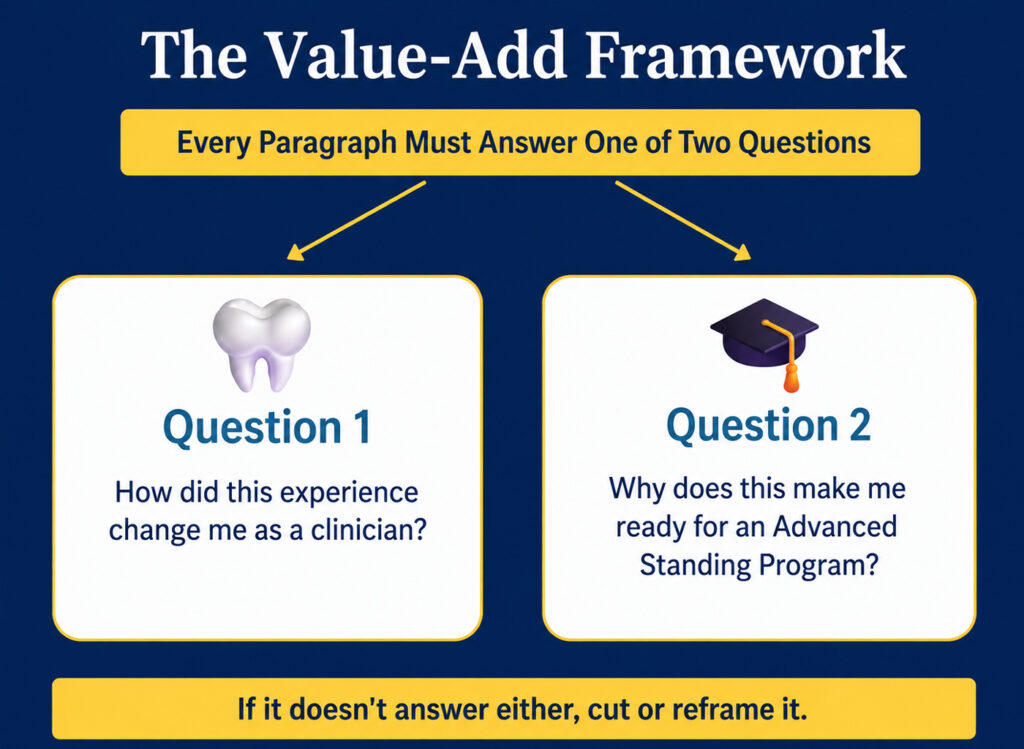
Every paragraph in your statement should answer one of two questions:
Question 1: How did this experience change the way I think as a clinician?
Question 2: Why does this experience make me more ready for an Advanced Standing Program specifically?
If a paragraph does not answer either question, cut it or reframe it.
Here is the practical application. Instead of writing:
“I completed five clinical rotations during my dental training, covering oral surgery, prosthodontics, pedodontics, periodontics, and restorative dentistry.”
Write the single rotation that challenged you the most and what it taught you about the kind of clinician you are becoming:
“My pediatric rotation at [Hospital] was the first time I understood that a child’s behavior in the dental chair is a direct reflection of the trust — or fear — that exists in the room. Managing that dynamic, often without the language or the luxury of time, forced me to develop a non-verbal communication toolkit I still use every day. It is the reason I specifically want to deepen my pediatric training in an Advanced Standing Program environment.”
Same background. Completely different impact.
The CV tells them what you did. The SOP tells them who it made you.
This is a distinction the Simpli Boards document review process is built around. Our mentors do not edit resumes into softer paragraphs. We help you excavate the experiences that actually shaped your clinical identity — and then we help you write them in a way that is impossible to ignore.
How to Turn Your Home Country Experience Into Your Competitive Advantage
This is where we want to speak directly to the experience of being an internationally trained
dentist applying to a U.S. or Canadian program.
There is a quiet fear that lives in many CAAPID applications. It is the fear that your home country experience is somehow lesser — that the resource limitations, the different protocols, the non-U.S. training environment are liabilities to be minimized or apologized for.
We want to be completely clear: that fear is wrong. And it is costing you interviews.
Your home country experience, framed correctly, is not a gap in your profile. It is evidence of exactly what Advanced Standing Programs are looking for.
Here is how to reframe the experiences you might be tempted to hide.
Working With Limited Resources → You Are a Problem-Solver
Many international dentists trained in environments where equipment, materials, or specialist referral networks were not always available. A U.S.-trained dentist who has only ever practiced in a fully stocked clinic has never had to develop the improvisation and triage skills that come from scarcity.
That is a skill set, Doctor. Own it.
“Training in a resource-limited setting taught me to diagnose with my senses before my instruments — a skill I carry into every clinical encounter.“
Treating a Diverse Patient Population → You Have Cultural Competency
Advanced Standing Programs in the United States and Canada serve increasingly diverse patient populations, including communities whose languages, cultural attitudes toward dental care, and systemic health conditions create genuine clinical complexity.
If you treated patients across multiple languages, cultures, or religious practices in your home country, that experience is directly applicable — and deeply valued.
Frame it not as a generality, but as a specific interaction:
“Navigating the cultural hesitancy around tooth extraction among my elderly patients from [cultural background] taught me that patient education is not a speech you deliver — it is a relationship you earn.”
Working as a Dental Assistant in the U.S. → You Have Humility and System Knowledge
We know this part stings. You ran a practice. You supervised staff. And now you are handing instruments to someone with far less clinical experience than you.
But this chapter of your story — told correctly — is one of the most powerful things in your application.
“Rather than simply waiting for my licensure process to conclude, I sought a dental assistant position at a U.S. practice. In eighteen months, I observed how American patients navigate dental anxiety, how the insurance-driven appointment structure differs from private practice in my home country, and how the clinical team dynamic functions differently in this environment. I arrived with a degree. I am leaving with context.”
That is not an applicant minimizing a gap in their resume. That is a clinician demonstrating that they approach every environment as an opportunity to learn. That is the colleague every program director wants in their program.
The Architecture of an Unforgettable Statement — A Structure Guide
Now that you understand the principles, here is how to structure the actual document.
The Opening: Do Not Waste It
Your first two to three sentences are the most read words in your entire application. Most
applicants waste them on a cliché.
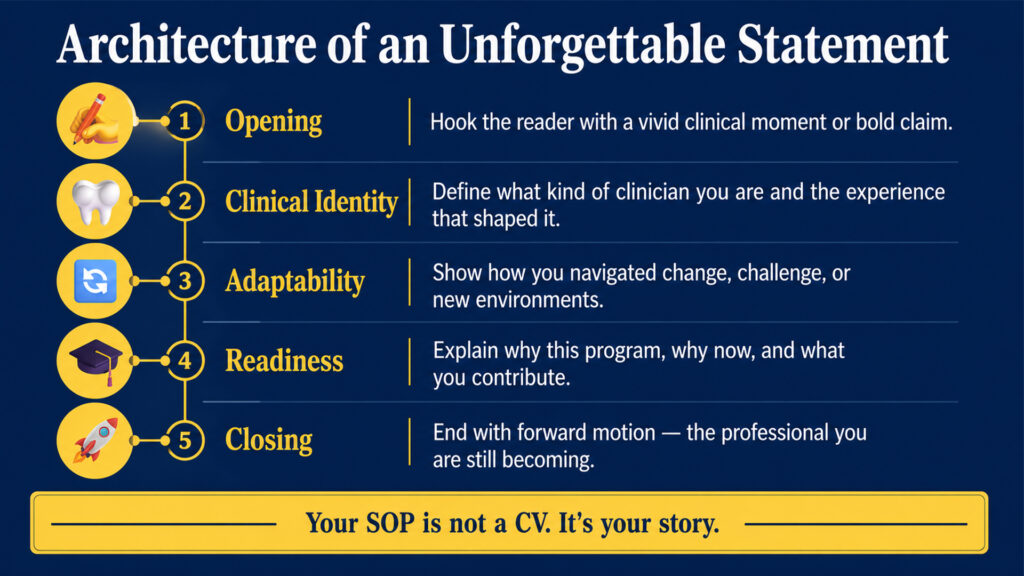
Your opening should do one of two things: drop the reader into a specific moment, or make a provocative, specific claim that demands they keep reading.
Examples of strong openings:
- “The most complex patient I ever treated had no dental disease. She had fourteen years of dental trauma and zero trust in a provider.”
- “I have performed over [X] extractions. The one I remember most vividly, I almost did not attempt.”
- “On my last day of practice before leaving [Home Country], a patient brought me a letter written by her daughter. I read it on the flight here. I still have it.”
These are not fictional. They are examples of the kinds of real clinical moments every dentist has — moments that have been sitting in their memory, waiting to be put on the page.
The Body: Three Core Sections
Body Section 1 — Clinical Identity: What kind of clinician are you, and what specific experience created that identity?
Body Section 2 — Adaptability and Growth: How have you demonstrated that you can navigate change, challenge, and a new environment?
Body Section 3 — Specific Readiness: Why this pathway, why now, and what specific contribution do you bring to the program — not what the program will give to you?
The Closing: End With Forward Motion
Avoid the weak summary closing: “For all of the reasons above, I believe I would be an
excellent addition to your program.”
Close with a forward-facing statement that communicates the clinician you are still becoming, and the specific ways this program is the next chapter of that journey.
“I am not applying to your program because I want to be a dentist in the United States. I already am one. I am applying because I believe the clinical environment you have built is the right place to complete the professional I am still becoming — and because I have something specific to contribute to the patients you serve.”
Common Mistakes That Are Silently Killing Strong Applications
Even well-intentioned applicants make these errors consistently. Review your draft against each one.
Mistake 1: Flattering the Program Without Specificity
“Your prestigious program has an outstanding reputation for clinical excellence.”
This adds nothing. Every school has heard this about themselves. If you are going to reference a specific program, reference something specific — a faculty member’s research, a clinical track, a community partnership. If you cannot do that, cut the flattery entirely.
Mistake 2: Apologizing for Your Timeline
Do not spend paragraph space explaining or excusing the years between your dental graduation and your CAAPID application. You do not owe an apology. You owe a narrative that makes the journey make sense.
Frame the timeline as evidence of intentionality, not delay.
Mistake 3: Using Passive Voice Throughout
“Patients were treated by me using…” versus “I treated patients with…”
Passive voice drains authority from your writing. It makes you sound tentative. You are a doctor with real clinical experience — write like one.
Mistake 4: Generic Program Fit Claims
“I believe your program’s values align perfectly with my own.”
What values? Aligned how? This sentence says nothing and occupies space that could be used for a real, specific claim.
Mistake 5: Writing in Translation Mode
This one is for our doctors whose first language is not English. The most common trap is translating your thoughts from your native language directly into English — including the sentence structure, the formality register, and the idioms.
The result is technically correct English that reads as foreign on the page.
The solution is not to hire a proofreader who fixes grammar. It is to work with someone who understands both the culture of U.S./Canadian medical writing and the content of your story — and can help you find the English-language voice that is authentically yours, not a formal translation of your native-language self.
This is precisely the work our document reviewers do at Simpli Boards — not correcting your English, but unlocking your voice in it.
Frequently Asked Questions About the CAAPID Personal Statement
📃 How long should the CAAPID Statement of Purpose be?
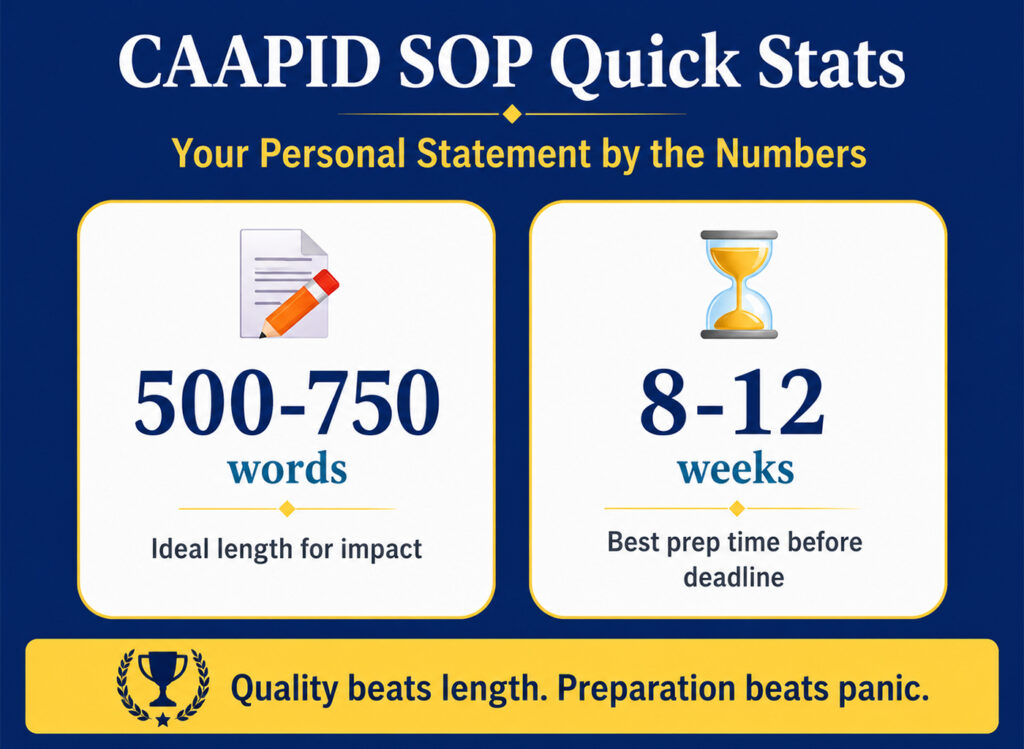
The CAAPID application typically requests a personal statement of approximately one page, though exact specifications can vary by program. Most competitive statements run between 500 and 750 words. Length is not the measure of quality — density of meaning is. A 600-word statement that contains two vivid clinical stories and a specific, forward-facing conclusion will always outperform an 800-word statement that narrates a CV.
✍️ Can I use the same personal statement for every CAAPID program I apply to?
A core narrative can and should be consistent across applications — your foundational story should not change. However, any program-specific references, clinical track mentions, or faculty acknowledgments must be tailored per school. Sending a statement to Columbia that references a Duke faculty member is the kind of mistake that ends candidacies quietly.
🏠 How do I talk about why I left my home country without sounding opportunistic?
Focus on what you are moving toward, not what you are moving away from. Committeesunderstand that the U.S. and Canadian dental systems offer training opportunities and professional environments that differ from many countries. You do not need to critique your home country’s system. Simply articulate what specific aspect of the U.S./Canadian clinical environment or training model represents the next chapter of the clinician you are becoming.
🏢 Should I mention the challenges I faced in the United States — like working non-clinical jobs?
Yes — if you can frame them as evidence of character and intentionality. Working as a dental assistant, rideshare driver, or other survival role while pursuing licensure is not a point of weakness. It is proof of commitment. The key is framing: you were not waiting — you were preparing, observing, and building the context that will make you a more effective clinician in this system.
� My English is not perfect. Should I ask someone to completely rewrite my statement?
No. A statement that does not sound like you will not survive a follow-up interview. What you need is a collaborator — someone who helps you find the right English words for your real stories, not someone who replaces your voice with theirs. The goal is an authentic narrative in polished English, not a ghostwritten document you cannot speak to in the interview room.
📢 What is the biggest single change I can make to my statement right now?
Identify the one clinical moment from your career that changed how you think as a dentist. Write
it in four sentences. Put it in your opening paragraph. The rest of the statement exists to
contextualize that moment and answer: “And here is what it means for the clinician I am still
becoming.”
⏳ How far in advance should I start working on my CAAPID personal statement?
Ideally, eight to twelve weeks before your application deadline — not because the writing itself takes that long, but because the self-reflection process does. The stories that make the best statements are not written in a single session. They surface gradually, through drafts, through mentorship conversations, and through the process of asking yourself hard questions about what you actually experienced and what it actually meant.
Your Next Step — Your Story Deserves to Be Told Right
Doctor, here is what we want you to take away from everything above.
You have a story that no one else in that applicant pool has. Your path — the country you trained in, the patients who trusted you without the resources you needed, the cultural code-switching you mastered on the way here, the quiet dignity of starting over in a system that does not yet recognize your title — that story is not a liability.
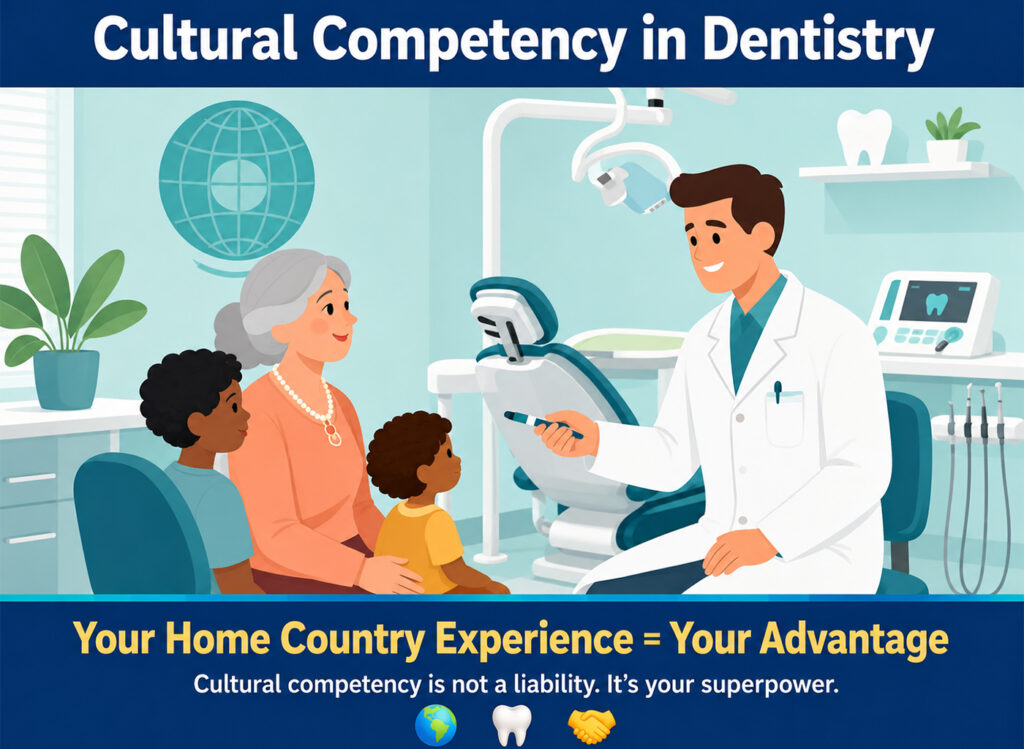
It is your superpower.
The only risk is telling it badly.
Generic writing is not a talent problem. It is a self-awareness problem, compounded by the enormous pressure of academic English writing conventions that train us to strip personality out of prose in the name of professionalism. International dentists face this challenge more acutely than most, not because they have less to say, but because the conventions of their academic training actively work against personal narrative.
The goal is not to sound more professional. The goal is to sound like the future colleague you already are.
Writing about yourself is genuinely difficult. Identifying the moments that matter, translating them into a language that may not be your first, and calibrating the tone between confidence and humility — all in 600 words — is a skill that takes time and outside perspective to develop.
That is exactly what the Simpli Boards document review process is designed to support.
Our mentors do not fix your grammar and send it back. We sit with you in the story. We ask the questions that surface the clinical moments you have forgotten to include. We help you hear how your narrative lands in the ears of someone who reads these statements for a living. And we polish your language until it sounds like the best, most articulate version of you — not a generic template, and not someone else’s voice wearing your name.
Because your CAAPID application is not just paperwork. It is your professional reintroduction to a system that has not yet met you.
Let’s make sure it is unforgettable.
🎯 Ready to Transform Your Statement of Purpose?
At Simpli Boards, our document revision experts help internationally trained dentists move from generic to interview-ready — by combining professional narrative coaching with deep knowledge of what CAAPID Advanced Standing Programs are actually looking for.
Get access to our full CAAPID application support system: statement review, mentor sessions, and the community of international dentists navigating this exact journey alongside you.
Or download our free CAAPID Application Roadmap — a step-by-step guide to building a complete, competitive application from personal statement to interview prep.
You already have the story. Let’s make sure it gets read.
Simpli Boards is a premium preparation and application support platform built exclusively for internationally trained dentists pursuing licensure and Advanced Standing Programs in the United States and Canada. Our team combines board exam preparation, application strategy, and document coaching into one integrated pathway — because passing the boards is only half the journey.
INBDE And AFK Courses offered by Simpli Boards
-
Select options This product has multiple variants. The options may be chosen on the product page Sale
AFK Mock Test
Number of Mock Tests to choose- 1/2/3 Channel: 100% Online Mock Test …CA$400.00 – CA$1,000.00Price range: CA$400.00 through CA$1,000.00 Select options This product has multiple variants. The options may be chosen on the product page -
AFK Advance Plus Premium
Channel: 100% Online Batch Starts In: September | April Includes– 480 hours …CA$2,500.00Original price was: CA$2,500.00.CA$2,000.00Current price is: CA$2,000.00. Add to cart -
Select options This product has multiple variants. The options may be chosen on the product page Sale
INBDE Mock Test
500 Questions based on current exam pattern Detailed discussion of 500 …CA$225.00 – CA$450.00Price range: CA$225.00 through CA$450.00 Select options This product has multiple variants. The options may be chosen on the product page -
INBDE Advance Plus Premium
Simpli Notes: 250+ Hours Study Material Lecture Videos Simpli Lecture: 100+ Hours …CA$2,250.00Original price was: CA$2,250.00.CA$1,345.00Current price is: CA$1,345.00. Add to cart -
INBDE Advance Plus
Simpli Notes: 250+ Hours Study Material Simpli Lecture: 100+ Hours Live …CA$1,650.00Original price was: CA$1,650.00.CA$970.00Current price is: CA$970.00. Add to cart -
INBDE Advance
Simpli Notes: 250+ Hours Study Material Simpli Tests: 6,000+ Question Bank Elite …CA$900.00Original price was: CA$900.00.CA$520.00Current price is: CA$520.00. Add to cart